
Epitalon Case Studies for Telomere Maintenance
A Practical Personal Case Study on Finding the Optimal Dose Over Time featuring Tony Pemberton
Epitalon is one of the most talked-about peptides in the longevity space, largely because of its ability to upregulate telomerase activity and, over time, influence telomere length. While the mechanism is compelling, dosing remains one of the most misunderstood aspects of Epitalon use.
This article outlines practical Epitalon dosing strategies, what I’ve observed across multiple personal cycles and in other individuals, and how to interpret telomere data realistically over time—without overreacting to short-term fluctuations.
Why Epitalon Dosing Is So Debated
Much of the confusion around Epitalon dosing comes from the original Russian research. Early studies used Epithalamin, a crude pineal gland extract, rather than isolated Epitalon. The exact concentration of Epitalon within Epithalamin was never clearly defined.
Because of this, assumptions were made—such as the idea that 1 mg of Epitalon equals ~10 mg of Epithalamin—but this ratio has never been definitively proven.
As a result, dosing protocols today range widely:
1 mg daily
2–3 mg daily
Even 5-10 mg daily in some cases
In practice, more is not always better.

My Personal Experience With Epitalon Dosing
Over several years, I’ve trialed multiple Epitalon protocols:
1 mg daily for 20 days (many cycles)
2 mg or 5mg daily for 20 days (early experimentation)
What I noticed:
Moving from 1 mg to 2 mg noticeably increased dream vividness and subjective sleep depth.
5 mg did not add further benefits and felt unnecessary.
Conversations with experienced peptide formulators (including industry experts) reinforced that higher doses may overshoot the optimal response.
The most consistent benefits—particularly around sleep quality—came from lower, repeatable dosing rather than aggressive protocols.

Sleep, Melatonin, and Telomere Biology
Epitalon’s influence on telomeres isn’t just direct via telomerase activation—it’s also indirect, through improved pineal function and melatonin regulation.
In my most recent cycle:
1 mg daily for 20 days
Sleep tracked before, during, and 30 days after the cycle
Observed changes including 10 days after tyhe cycle:
Sleep performance: +6%
Restorative sleep: ~+13%

Note: I was also using Delta Sleep-Inducing Peptide (DSIP) during this period, which likely contributed. However, Epitalon’s pineal modulation appears to have a lasting effect beyond the dosing window.
Poor sleep, insomnia, emotional stress, and metabolic dysfunction are all strongly associated with accelerated telomere shortening. Improving sleep quality alone can meaningfully reduce telomere attrition over time.
Understanding Telomere Testing: Why Small Changes Matter
Telomere length is not the best single marker of biological age. On its own, it explains only a small percentage of health outcomes. However, as a relative, longitudinal marker, it’s extremely useful.
Key points:
Average telomere attrition is ~50–100 base pairs per year
Quarterly testing should aim for:
Maintenance, or
Small incremental increases
Even stability over time is a win, especially under anabolic or high-stress conditions
Case Study: Telomere Changes Over Time
My own data:
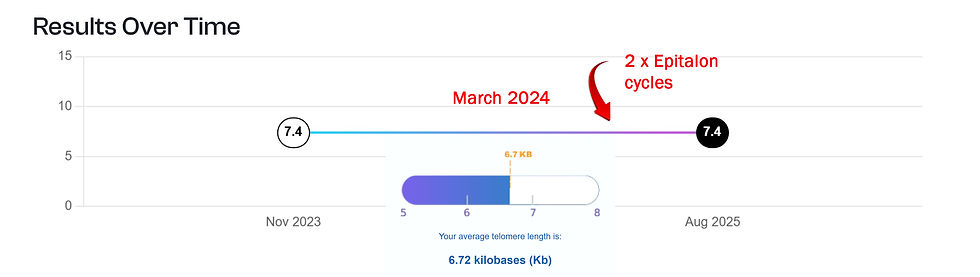
June and November 2023: Telomeres were 7.28 and 7.18 kb respectively
March 2024: Telomeres dropped to ~6.75 kb (≈5th percentile) due to long working hours
June 2024 (post-Epitalon): Increased to ~7.18 kb
Later cycles: Gradual increases to ~7.25 kb, then stabilisation (July & November 2025) around ~7.3 kb (=slightly above 50th percentile)
This occurred while:
Improving sleep
Reducing chronic inflammation
Avoiding extreme calorie restriction
Later adding lean muscle mass
Importantly, during periods of higher protein intake and growth-hormone secretagogue use, my pace of aging worsened, yet telomeres remained stable—suggesting Epitalon helped buffer telomere attrition despite increased cellular turnover. It also increased by 6 points to 0.9 in March 2024 during period with excessive working hours.


What I’ve Seen in Other People
Across multiple individuals using Epitalon:
Common outcomes:
Telomere maintenance over 6–24 months
Prevention of expected age-related shortening
Occasional modest elongation with consistent protocols
An Occasional Pattern:
Some people initially see telomere shortening, often due exessive pursuit of tried and true methods:
Over-fasting
Excessive training
Early-morning high-intensity exercise that sacrifices sleep
Elevated cortisol from lifestyle “over-optimization”
Please Note:
Until December 2025, TruAge PACE was available as a standalone test separate from TruAge Complete. When you ran PACE as an individual test between larger TruDiagnostic panels, those results weren’t displayed inside the main TruAge Complete report

Ironically, the stress of trying to be too longevity-focused can accelerate telomere attrition, which can happen faster than telomere extension.
Epitalon appears particularly useful in:
Recovering from stress-induced telomere loss
Re-establishing baseline telomere stability
Dosing Strategy: Less, Repeated, and Timed Correctly
Based on both personal and observed data:
Common effective protocols:
1 mg daily for 10–20 days
2–2.5 mg daily for 20 days (upper practical range)
More is not necessarily better—this aligns with newer data (including recent academic work highlighting dose-dependent telomerase responses).
Testing timing matters:
Telomerase upregulation peaks ~21 days after dosing
Telomere elongation follows more slowly
Best practice:➡️ Test telomeres ~3 weeks after the final injection
This allows:
Pineal modulation
Sleep normalization
Telomerase expression to stabilise
Long-Term Strategy: Quarterly “Top-Ups”
Epitalon works best as a long-term maintenance tool, not a one-off intervention.
A practical approach:
Quarterly Epitalon cycles
Moderate dosing
Focus on sleep, inflammation, and stress management in parallel
Even if telomeres don’t elongate every quarter, preventing decline over years is a powerful outcome.
Final Thoughts
Longevity isn’t about extremes. Chasing perfect biomarkers through aggressive fasting, overtraining, or excessive supplementation can backfire.
Epitalon appears most effective when used:
Conservatively
Repeatedly
In conjunction with improved sleep and reduced stress
Small, sustained changes—rather than dramatic short-term wins—are what preserve telomere length over time.
Maintenance is progress. Elongation is a bonus.
Disclaimer
The peptides referenced in this article, including Epitalon, were sourced personally by the author from Elvian Labs, selected due to their provision of up-to-date independent testing for purity and microbial safety. This reference is provided for transparency only and does not constitute a recommendation, endorsement, or medical advice.
Any client results discussed are shared voluntarily by those individuals, based on peptides they chose to source and use under their own initiative.
Epic Genetics does not prescribe, recommend, supply, or advise on the use of peptides or other prescription-only substances.
The information presented is for educational and informational purposes only and should not be interpreted as medical guidance. Individuals are responsible for their own health decisions and should consult an appropriately qualified healthcare professional before using any pharmacological or peptide-based interventions.


Comments