
SS-31 (Elamipretide) Experience
My Cycle, the Human Data, and How I’m Tracking Results
By Tony Pemberton — Founder of Epic Genetics
Mitochondrial health is one of those “deep-root” levers in aging and performance. If your mitochondria are inefficient, ATP production drops, reactive oxygen species rise, fatigue climbs, and downstream systems (kidney, heart, muscles, brain) start paying the price.
That’s why I’ve been paying close attention to SS-31 — also known as elamipretide — a mitochondria-targeting tetrapeptide that has been gaining real traction in both science and clinical medicine.

In this article I’m going to cover:
What SS-31 is and how it works
The new human evidence (and what FDA approval really means)
Lifestyle factors that seem to synergize with SS-31
My personal SS-31 cycles and results
My next low-dose 8-week experiment + biomarkers I’ll track
Important disclaimers and sourcing
This is purely a record of my own personal research and biomarker tracking — not medical advice.
What SS-31 Is (And Why Cardiolipin Matters)
SS-31 (elamipretide) is a mitochondria-targeted peptide that binds to cardiolipin, a fat-like molecule that sits in the inner mitochondrial membrane. Cardiolipin is basically “structural scaffolding” for the electron transport chain. When cardiolipin becomes oxidized or damaged, mitochondria lose their shape and efficiency, and ATP output falls.
A simple analogy: cardiolipin is like the elastic in an old jumper. After hundreds of washes, it gets stretched, warped, and doesn’t hold form anymore. Same story in mitochondria — oxidative stress “warps” cardiolipin, and energy production becomes sloppy, inefficient, and inflammatory.
Elamipretide’s key claim to fame is that it stabilizes cardiolipin and mitochondrial structure, improving electron transport chain efficiency and reducing runaway oxidative stress. MDPI+1
The Human Data and FDA Approval (Barth Syndrome)
This peptide now has something most longevity compounds don’t: human clinical outcomes and FDA approval.
In September 2025 the FDA granted accelerated approval to elamipretide (brand name Forzinity) for Barth syndrome, a rare, life-threatening mitochondrial disease. U.S. Food and Drug Administration+1
Barth syndrome patients have severe mitochondrial dysfunction, fatigue, muscle weakness, and major cardiac issues. In the long-term TAZPOWER follow-ups, patients showed meaningful improvements in fatigue and functional performance, including better walking capacity and muscle strength over time. Pharmacy Times+1
It’s worth noting the approval pathway was accelerated and not without debate inside the FDA, which is normal in ultra-rare diseases where large trials are hard to run. Reuters+1
The important practical takeaway:Elamipretide is no longer just “mouse magic.” We now have real human evidence that stabilizing cardiolipin can improve energy capacity and fatigue in a mitochondrial disease state. That’s a big milestone for mitochondria-targeted medicine. U.S. Food and Drug Administration+1
The open question — and the reason I’m experimenting carefully — is:
What dose is meaningful in a healthy or mildly unhealthy person?
In Barth syndrome trials, dosing was far higher than what biohackers typically use (around 40 mg daily subcutaneously in some protocols). So translating this into healthy-person optimization is not straightforward.
Lifestyle Factors That May Synergize With SS-31
If SS-31 is trying to restore cardiolipin integrity, you want to avoid the things that keep damaging cardiolipin in the first place.
From the research and from what I’ve seen in practice, the biggest “cardiolipin oxidizers” include:
1. Chronic high glucose + glycation
Advanced glycation end products (AGEs) drive ROS and mitochondrial membrane damage, especially in dense-mitochondria tissues like kidney and heart. Keeping glucose stable should reduce cardiolipin oxidation pressure. MDPI
2. Highly oxidized seed oils (omega-6 / linoleic acid)
It’s not just omega-6 itself — it’s oxidized linoleic acid after repeated high-heat cooking (deep frying, battered foods, old restaurant oils). These lipids are aggressive drivers of lipid peroxidation in mitochondrial membranes. MDPI
3. Chronic overeating
Overfueling mitochondria 24/7 increases membrane stress and ROS. I’m more of a “steady-Eddie intake” guy rather than swing-dieting from overeating to harsh cuts.
4. Heavy metals
Lead, vape heating elements, polluted water — they all nuke mitochondria by driving oxidative stress. For me, that’s meant filtering water aggressively and lowering any heavy metal exposure wherever possible. MDPI
Think of SS-31 as a repair crew, not a magic shield. If you keep setting fires in the mitochondria, don’t be surprised if results are muted.
My SS-31 Cycles So Far (And What I Noticed)
Cycle 1 (Oct last year): bigger protocol
This is the cycle where I saw the biggest change.
Over the following months, my kidney age improved by 2.84 years.That’s a huge reversal, especially considering kidney tissue is mitochondria-dense and highly sensitive to cardiolipin dysfunction.
Was SS-31 the only driver? Probably not — biomarkers are multi-factorial.But the association was strong enough that it kept SS-31 on my radar.
Cycle 2: moderate “multi-vial” run
Later I ran a more moderate cycle: three 10 mg vials across about 9–10 days (~3.3 mg per shot).
Again, kidney markers stayed favorable relative to baseline.
Cycle 3 (April): light top-up
I did a simple maintenance top-off: 1 mg daily for 10 days.
By late July my kidney age had drifted up about a year — and I think that was mostly confounding lifestyle/diet changes, especially increased protein intake and some seed-oil creep.
That’s the reality of self-experimentation: SS-31 doesn’t exist in a vacuum.
Cycle 4: another 1 mg top-up
Just finished another 10-day “dent the number” top-up to see if I can push kidney age back down while I tighten lifestyle inputs.
The Biomarkers I Care About Most
1. Kidney age + traditional kidney function markers
Kidney health has been the most noticeable “signal” area for SS-31 in my experience and from what others have reported.
I’m watching:
creatinine
cystatin-C
albumin
combined kidney age score
Kidneys are mitochondria-hungry and especially vulnerable to oxidative cardiolipin damage, so this makes mechanistic sense. MDPI+1
2. ATP5B (mitochondrial efficiency marker)
ATP5B reflects inefficiency across mitochondrial complexes.If cardiolipin is damaged, ATP5B tends to drift the wrong way.
Mine sits around the 45th percentile, so I’ve got room to improve. This is one of the most direct epigenetic markers tied to SS-31’s mechanism.
3. DRP1 (mitochondrial fission marker)
DRP1 is linked to mitochondrial fission. Too much fission over time = dysfunctional fragmented mitochondria.
Mine is around the 75th percentile, which is not where I want it. If SS-31 improves morphology and reduces excessive fragmentation, I want to catch that signal here.
My Next Experiment: Low-Dose SS-31 for 8 Weeks
Here’s the plan I’m genuinely excited about:
Protocol
1 mg SS-31 daily
8 weeks
Goal: see whether a healthy person can get measurable benefits from a low, budget-friendly dose if lifestyle inputs are clean.
What I’ll Track
Mitochondrial / performance:
VO₂ max trend via cardio output
VO₂ max cross-check using VentriJect
Endurance retention (I’m trying to avoid the 10% cardio drop-off I’ve seen in past years)
Metabolic:
continuous glucose monitor data over the full 8 weeks
fasting glucose stability
Epigenetics & organ ages:
quarterly TrueAge / TrueHealth epigenetic testing (TruDiagnostic)
ATP5B and DRP1
kidney age (primary)
heart age (secondary)
This is basically a long-form health MOT for mitochondrial function — using both performance data and epigenetic clocks to see if anything shifts meaningfully.
If ATP5B improves and DRP1 normalizes, that’s a strong argument that low-dose SS-31 can move the needle outside of disease states.If not, I’ll either bump dose (maybe 2 mg) or shelve it as a “disease-level tool only.”
Final Notes on Sourcing and Safety
For transparency:
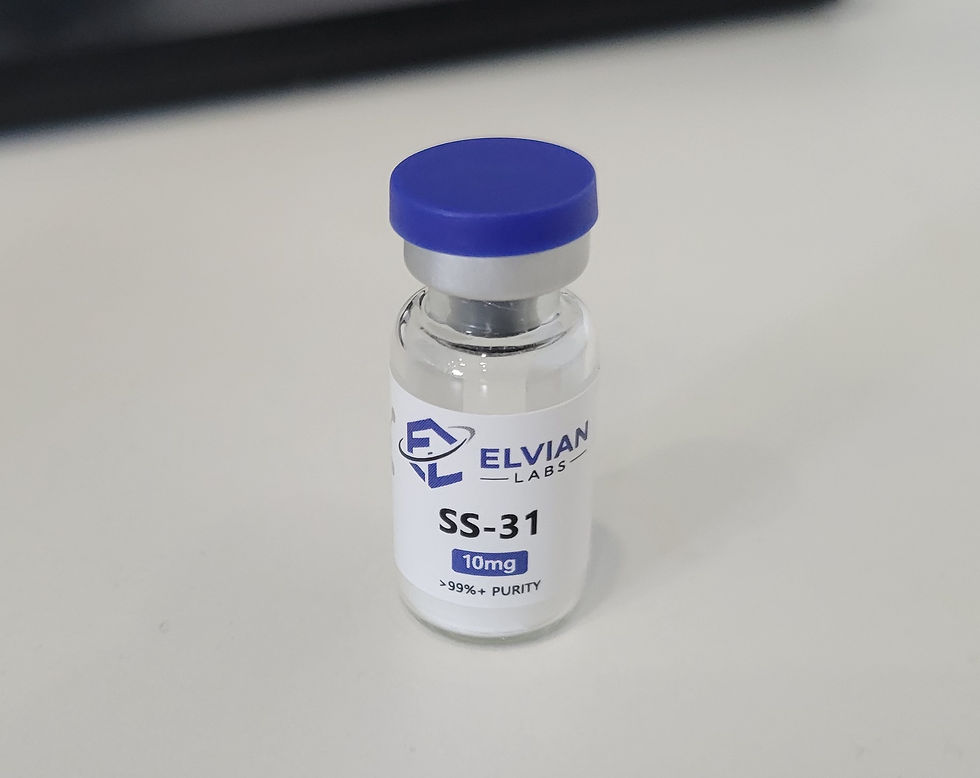
I previously sourced SS-31 from Elvian Labs for my personal research.
I chose them because their SS-31 has sterility testing.
This is not a product recommendation and not medical advice.
My use is for personal research only, based on the compound’s human clinical background and FDA-approved status in a rare mitochondrial disease. U.S. Food and Drug Administration+1
Important disclaimer:This article is for educational purposes and documents my own experimentation. It does not constitute medical advice, diagnosis, or treatment. Peptides like SS-31 should not be used without qualified medical supervision. Results in disease populations do not automatically translate to results in healthy individuals.
If you want to track your own mitochondrial and biological aging trends, consider structured longitudinal testing such as TrueAge / TrueHealth epigenetics, plus a regular health MOT approach that covers major organ systems and metabolic markers.


Comments