
PE-22-28: Neuroplasticity, Brain Age & Our First Human Case Study
Updated: 5 hours ago
Can PE-22-28 influence neuroplasticity, stress resilience and brain ageing? We examine the published research alongside our first longitudinal case study.
PE-22-28 is one of the more unusual research peptides we have followed at Epic Genetics. Unlike many peptides associated with metabolic health, recovery or body composition, PE-22-28 has attracted interest primarily because of its effects on the brain in preclinical research — particularly TREK-1 signalling, neurogenesis, synaptogenesis and antidepressant-like behaviour.
The important caveat comes first: PE-22-28 remains an experimental research compound. There are currently no controlled human clinical trials establishing its safety or efficacy. The published evidence is predominantly from cell and animal research.

However, this also makes longitudinal human observations particularly interesting.
Epic Genetics founder Tony Pemberton completed two separate PE-22-28 research cycles during 2026, while continuously tracking stress, wellbeing and epigenetic biomarkers. His first 28-day cycle began in mid-April, followed several months later by a second cycle leading up to his August testing.
The subjective observations were remarkably similar between the two cycles. More interestingly, his May-to-August epigenetic testing subsequently showed a 2.3-year improvement in biological brain age, alongside several changes in neurocognitive and stress-associated biomarkers.
That doesn't prove PE-22-28 caused those changes. But it gives us some interesting reference points for what we intend to track next.
What is PE-22-28?
PE-22-28 is a seven-amino-acid peptide developed from spadin, an endogenous peptide associated with the sortilin pathway.
Its principal research target is TREK-1, a two-pore-domain potassium channel expressed in the nervous system and implicated in neuronal excitability and mood regulation.
The original PE-22-28 research found extremely high affinity for TREK-1, with an IC50 of approximately 0.12 nM, compared with 40–60 nM for the longer parent peptide spadin.
Why does that matter?
TREK-1 has emerged as an interesting experimental target in depression research. Earlier work showed that mice lacking TREK-1 display depression-resistant behavioural characteristics, while pharmacologically blocking TREK-1 with spadin produced antidepressant-like effects in several animal behavioural models.
PE-22-28 was subsequently developed as a smaller and more potent TREK-1-blocking peptide.
PE-22-28 and antidepressant-like behaviour
The 2017 PE-22-28 study used several experimental endpoints.
In the forced-swim test, mice receiving PE-22-28 and related spadin analogues demonstrated significantly reduced immobility. Researchers also used the novelty-suppressed feeding test, where PE-22-28 reduced the latency before mice approached and ate food following four days of treatment.
These tests shouldn't be described as directly measuring human happiness or depression. They are behavioural models used in antidepressant research.
The speed of the response was particularly interesting.
Traditional antidepressant-associated changes in neurogenesis generally require longer exposure in these animal models. Earlier spadin research found increased hippocampal neurogenesis and CREB activation after only four days, whereas four days of fluoxetine did not produce the same neurogenic response under those experimental conditions.
PE-22-28 subsequently produced a similarly rapid neurogenic signal.
And this is where the research becomes particularly interesting from an ageing and neuroplasticity perspective.
PE-22-28, neurogenesis and neuroplasticity
Neuroplasticity describes the brain's capacity to change its structure and functional connections in response to experience.
This includes forming and strengthening synapses, reorganising neuronal networks and, within specific brain regions, generating new neurons.
After only four days of treatment, PE-22-28 increased BrdU-positive cells in the hippocampus of mice — an experimental marker used to assess newly generated cells. The researchers reported approximately 1,736 BrdU-positive cells following PE-22-28 compared with 899 in saline-treated animals.
That's roughly a 93% higher count in this particular experimental model.
PE-22-28 and related analogues also increased PSD-95, a protein associated with postsynaptic structure and synaptogenesis.
The wider spadin/TREK-1 research provides another important clue.
Spadin has been shown experimentally to increase BDNF (brain-derived neurotrophic factor) alongside proteins involved in synapse formation, including PSD-95 and synapsin. Researchers also observed an increased proportion of mature neuronal spines.
BDNF is particularly interesting in longevity research because it plays an important role in neuronal survival, learning, memory and plasticity.
It would therefore be premature to claim that PE-22-28 improves cognition or reverses brain ageing in humans. But the combination of TREK-1 inhibition + neurogenesis + synaptogenesis + the wider spadin/BDNF pathway provides a credible biological reason for investigating these outcomes.
Epic Genetics Case Study: Tony Pemberton's first 28-day cycle
Tony's first PE-22-28 cycle began in mid-April 2026 and lasted 28 days.
Rather than relying purely on how he felt, Tony compared the period with his preceding baseline data.
One of the first observations came from his wearable stress data.
During the opening weeks, his weekday stress readings were noticeably lower than during the previous month. This was particularly interesting because his workload had not disappeared. The subjective difference was less about feeling sedated and more about how he responded to everyday pressure.
At the same time, Tony began noticing something harder to quantify.
New ways of organising work seemed to emerge more readily. He found himself developing new workflows with his team, approaching existing problems differently and generally thinking more dynamically about how work could be structured.
“The most noticeable thing wasn't feeling stimulated or dramatically different. I just seemed to keep seeing better ways of doing things. New workflows would occur to me, I'd implement them with the team and generally felt more positive about solving problems rather than dwelling on them.” — Tony Pemberton
This is obviously subjective.
However, it was interesting in the context of the experimental evidence around synaptogenesis and neuroplasticity.
The second cycle: could the effect be repeated?
A single experience can easily be coincidence, expectation or normal variation.
Tony therefore completed a second PE-22-28 cycle several months later.
Once again, he noticed a similar pattern.
There was a generally more positive mindset, greater cognitive flexibility and improved ability to move on from stressful situations.
This time there was also real-world adversity in his working life, providing a rather different test from the first cycle.
Rather than eliminating stress, the perceived effect seemed to be improved resilience — experiencing the setback but returning to productive thinking more quickly afterwards.
That distinction is important.
The experience wasn't simply “feeling happier”. It was closer to an increased tendency to search for another solution.
What happened to Tony's biological brain age?
This is where we can begin adding objective data.
Tony completed TruDiagnostic testing on 18 May 2026, shortly after his first cycle, followed by another blood collection on 21 August 2026.

His SYMPHONY Brain biological age improved by 2.3 years, moving from:
May: 7.4 years older than chronological age
August: 5.1 years older
(Symphony Algorithm updated November 2025)
The direction is encouraging, although brain age remained above Tony's chronological age and therefore still has considerable room for improvement.
More importantly, this result cannot be attributed to PE-22-28 alone.
Tony uses multiple longevity interventions, trains regularly and made other changes between May and August. An N=1 longitudinal case study can identify an interesting association; it cannot establish causation.
The TrueHealth neurocognitive biomarkers reinforce the need for that caution because the results were mixed rather than universally positive.
Quinolinate, described on the report as a brain-inflammation marker, improved from the 86th to 70th percentile. Neurosecretory protein VGF moved from the 96th to 81st percentile, also towards its stated optimal range.


However, Neurogranin moved from the 41st to 9th percentile, while dopamine metabolites moved from the 16th to 99th percentile. Progranulin and TGF-beta also shifted away from their respective stated optimal ranges.

In other words, this wasn't a clean story where every brain-associated biomarker improved.
That's exactly why we want to continue measuring it.
Research Disclaimer
These case studies are observational and are presented for educational and research purposes only. They do not demonstrate that PE-22-28 caused the changes described and should not be interpreted as medical advice or evidence of efficacy or safety. PE-22-28 is an experimental research peptide with limited human data, and its long-term safety and efficacy have not been established.
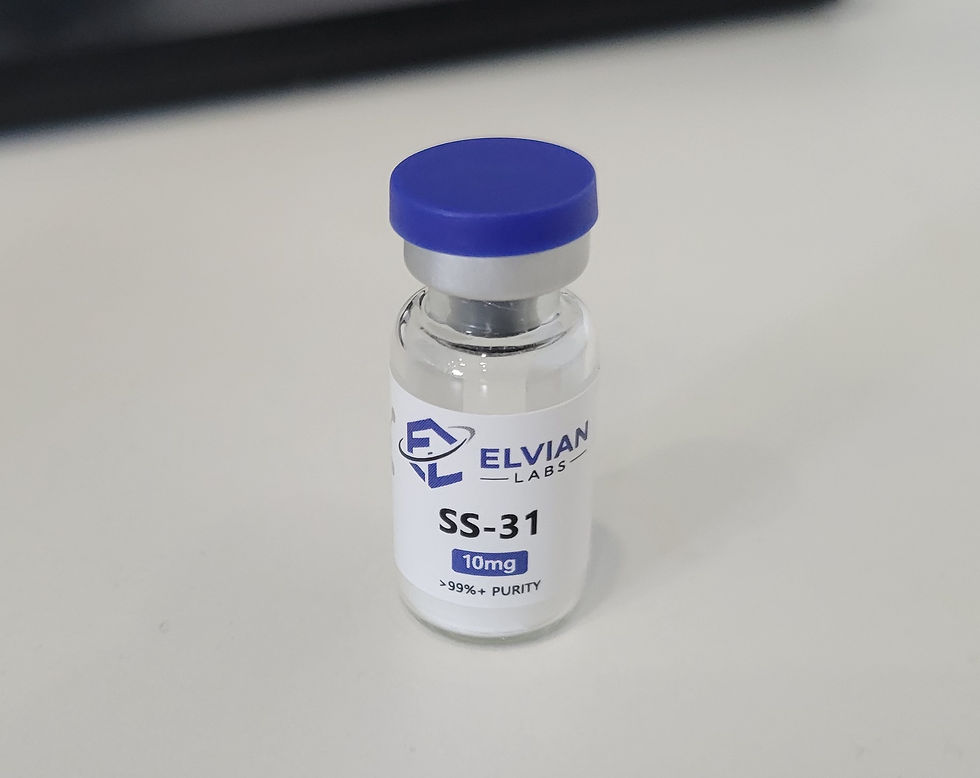
Tony and the clients featured in these case studies sourced their UK research peptides through Elvian Labs, selected due to the availability of recent independent product testing alongside periodic sterility testing.
An interesting stress signal
There was another notable change outside the neurocognitive panel.
Vanillylmandelic acid (VMA), an epigenetically estimated marker associated with catecholamine/adrenal activity, moved from the 90th percentile in May to the 37th percentile in August — directly into Tony's stated optimal range.

His kynurenine result also moved slightly in the favourable direction, from the 94th to 91st percentile, although it remained well outside the optimal range.
Again, there are too many confounding variables to attribute either change specifically to PE-22-28.
But Tony's subjective reports during two separate cycles — lower perceived stress, a more positive outlook and greater resilience — make stress-associated biomarkers particularly interesting endpoints for future PE-22-28 case studies.

What about telomeres?
Tony's results produced one more unexpected finding.
His Telomere Biological Age improved from 3.9 years older than chronological age in May to only 0.6 years older in August — a 3.3-year movement.
His reported telomere-length value itself remained unchanged at 7.2, due to reduction one decimal place with TruAge updated report 2025 style report. This result needs to be interpreted carefully and certainly cannot be described as evidence that PE-22-28 lengthened his telomeres.
Nevertheless, stress and telomere biology are connected.
Human meta-analyses have found associations between greater psychological stress/adversity and shorter telomeres, although effect sizes are generally small and the literature is heterogeneous and largely observational.
That leads to an interesting hypothesis rather than a conclusion:
“It wouldn't surprise me if, indirectly, PE-22-28 eventually showed an association with better telomere maintenance in people suffering from high chronic stress. Stress is associated with telomere attrition, so if something genuinely improves stress resilience over the long term, it's an interesting secondary area to investigate. But at this stage that's a hypothesis, not something we can say PE-22-28 does.” — Tony Pemberton
This is precisely the type of relationship that longitudinal epigenetic testing may eventually help investigate.
What have other people reported?
Since Tony began researching PE-22-28, Epic Genetics has also received feedback from a small number of people who have experimented with the compound independently.
The recurring themes have been surprisingly similar: a perceived improvement in mood, more positive thinking, greater adaptability and the feeling of spotting alternative ways of approaching work or problems.
Some have described this as feeling more “neuroplastic”.
Scientifically, we cannot know whether that perception represents increased neuroplasticity without controlled testing. Expectations, placebo effects and unrelated lifestyle changes are obvious confounders.
But the similarity between those descriptions and Tony's observations gives us a useful set of hypotheses for the next stage.
What we'll measure next
Future Epic Genetics PE-22-28 case studies will move beyond subjective mood alone.
We're particularly interested in tracking biological brain age, neurogranin, quinolinate, VGF, progranulin, dopamine-associated markers, stress biomarkers and inflammatory signalling, alongside validated subjective measures of stress, resilience and cognitive flexibility.
BDNF is another particularly interesting reference point because the broader spadin/TREK-1 literature has demonstrated BDNF-associated signalling alongside neurogenesis and synaptogenesis.
The objective isn't to prove that every biomarker improves.
In fact, Tony's first dataset already shows why that would be unrealistic. Some brain and stress-associated measurements improved substantially, while others deteriorated.
The more useful question is whether repeatable patterns emerge across multiple individuals and repeated testing.
The bigger picture
PE-22-28 is interesting because its research extends beyond the conventional idea of simply increasing or decreasing a neurotransmitter.
The preclinical work points towards a broader model involving TREK-1 inhibition, hippocampal neurogenesis and synaptogenesis, with related spadin research also implicating CREB and BDNF signalling.
For Tony, two separate cycles were accompanied by similar subjective experiences: lower weekday stress, a more positive outlook, new approaches to existing workflows and greater resilience when circumstances became difficult.
Between his May and August epigenetic tests, his biological brain age subsequently improved by 2.3 years, while one of the largest stress-related movements was VMA shifting from the 90th to 37th percentile.
Those results are intriguing.
They are not evidence that PE-22-28 caused the improvements, and the absence of controlled human trials means claims about human efficacy or long-term safety would currently go beyond the science.
But that's exactly what makes PE-22-28 worth following.
Rather than asking whether an experimental peptide simply “works”, our aim is to build longitudinal data around a more useful question:
If PE-22-28 genuinely influences neuroplasticity and stress resilience in humans, can we eventually see its fingerprint in objective measures of brain ageing and neurocognitive health?
For now, we have an interesting first case study.
The next step is more data.


Comments