
SS-31 (Elamipretide) Peptide: A Real-World Case Study Review of Mitochondrial Optimisation
Updated: Jul 15
Introduction
Mitochondrial dysfunction is increasingly recognised as one of the earliest drivers of ageing, metabolic disease and declining physical performance. As the cell's energy-producing organelles become less efficient, oxidative stress rises, ATP production falls, and tissues with high energy demands—including the heart, kidneys, brain and skeletal muscle—become increasingly vulnerable.
One peptide attracting growing interest in longevity and mitochondrial research is SS-31, also known as Elamipretide. Unlike mitochondrial signalling peptides such as MOTS-c, SS-31 works by binding directly to cardiolipin, a phospholipid found within the inner mitochondrial membrane that plays a central role in electron transport and ATP production.
While published human data continues to grow, real-world longitudinal biomarker data remains limited.
This article summarises five client case studies, each comparing approximately three months of biomarker changes following 60-70 day SS-31 peptide cycles, alongside Tony Pemberton's own detailed tracking using continuous glucose monitoring (CGM), epigenetic testing and performance metrics.
For readers interested in our previous mitochondrial peptide review, you can also read our MOTS-c case study review, where we observed complementary effects on mitochondrial dynamics:
What is SS-31?
SS-31 (Elamipretide) is a synthetic mitochondrial peptide designed to bind to cardiolipin, an important phospholipid within the inner mitochondrial membrane.
Cardiolipin helps organise the electron transport chain, allowing mitochondria to generate ATP efficiently while minimising reactive oxygen species (ROS).
As cardiolipin becomes oxidised through ageing, metabolic dysfunction and excessive energy intake, mitochondrial efficiency gradually declines.
Unlike many peptides, SS-31 does not appear to work through a traditional cell receptor. Instead, it acts directly within the mitochondria, making it mechanistically distinct from peptides such as MOTS-c.
Where MOTS-c is often described as a metabolic signalling peptide, SS-31 appears to function more as a mitochondrial repair peptide, supporting the structural integrity of the mitochondria themselves.
"Rather than forcing mitochondria to work harder, I see SS-31 as repairing the engine before asking it to produce more power."— Tony Pemberton

Study Design
This review summarises data voluntarily shared by five clients who independently chose to use SS-31 peptide and compare biomarker changes over approximately three months.
The purpose was not to perform a controlled clinical trial, but to identify consistent trends across real-world use.
Across the five clients:
Cycle length: 60-70 days
Daily dose: 1-2 mg
Biomarkers assessed approximately every three months using TruHealth epigenetic testing
Additional continuous glucose monitoring available in selected individuals
Interestingly, the two clients using 2 mg daily generally demonstrated larger improvements than those using 1 mg daily.
While this remains a small observational dataset, it raises the possibility that longer, lower-dose SS-31 peptide dosage cycles may produce greater cumulative mitochondrial adaptations than the shorter, higher-dose cycles commonly discussed within the biohacking community. Although the optimal SS-31 peptide dose per day and SS-31 dosing protocol have yet to be established in controlled human studies, our observations suggest that extended lower-dose protocols may warrant further investigation.
Key Finding #1: ATP5B Improved Significantly
One of the clearest findings involved ATP5B, a subunit of ATP synthase responsible for producing ATP.
When ATP5B normalises toward healthier ranges it suggests improved mitochondrial efficiency rather than simply greater mitochondrial output.

Across the five clients:
Average ATP5B improvement: +18.5 points
This represents almost double the improvement observed in our previous MOTS-c review.
Potential implications include:
Improved ATP production
Better recovery
Increased mitochondrial efficiency
Improved metabolic resilience
Rather than aggressively stimulating energy production, SS-31 appears to improve how efficiently existing mitochondria function.
Comparison with MOTS-c
Interestingly, comparing the two mitochondrial peptides reveals different strengths.
Our previous MOTS-c review demonstrated larger improvements in DRP1, a marker involved in mitochondrial fusion and fission.
SS-31, however, appeared to produce substantially larger improvements in ATP5B.
This supports the idea that the two peptides may work through complementary mechanisms rather than competing ones.
Key Finding #2: Mitochondrial Dynamics Also Improved
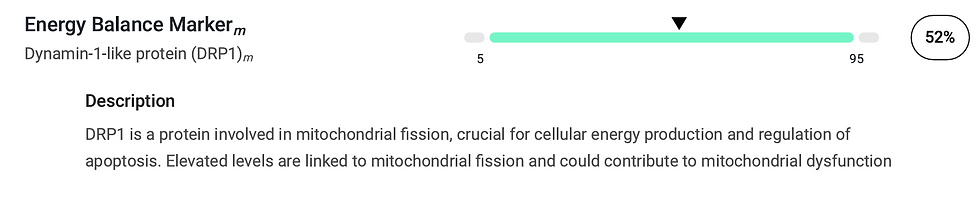
The second mitochondrial marker examined was DRP1 (Dynamin-related Protein 1).
DRP1 regulates mitochondrial fission.
Too much activity can result in fragmented, stressed mitochondria.
Too little activity may impair mitochondrial quality control.
The healthiest state appears to lie somewhere near the middle, reflecting an appropriate balance between fusion and fission.
Across the five clients:
Average DRP1 normalisation: +7 points
Although smaller than the improvements previously observed with MOTS-c, the results suggest SS-31 may still contribute towards healthier mitochondrial dynamics, albeit through a different primary mechanism.
Key Finding #3: Glucose Responses Were More Individualised
One of the most interesting findings was that glucose responses appeared more variable than those seen with MOTS-c.
Across all five clients:
Average glucose marker improvement: 9 points
Average epigenetic HbA1c improvement: 6 points
However, responses varied considerably.
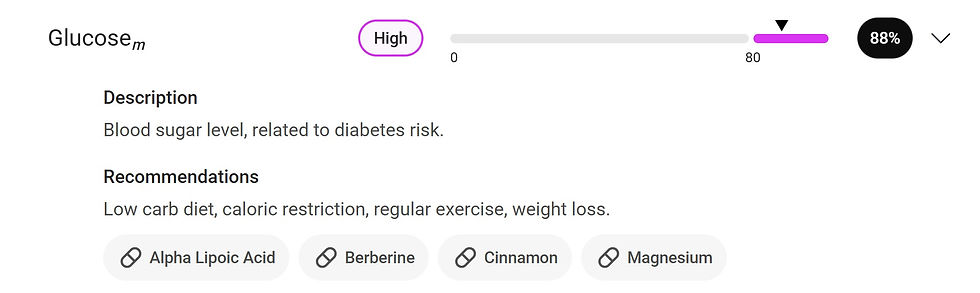
One client demonstrated a remarkable 38-point improvement in the TruHealth glucose marker.
Conversely, another client's glucose marker increased by 3 points, despite their HbA1c still improving by 2 points.
This variability suggests that repairing cardiolipin and improving mitochondrial efficiency does not necessarily produce identical glucose responses in every individual.
Before (2mg group)
After (2mg group)

Some individuals appear to be "hyper-responders", while others demonstrate more modest changes despite similar protocols.
Response is likely to be linked to current metabolic health, as individuals with glucose and HbA1c levels towards the higher end of the reference range appear to show a greater response to SS-31.
Compared with MOTS-c, glucose handling following SS-31 may therefore depend more heavily on an individual's baseline mitochondrial health, metabolic flexibility and overall lifestyle.
Understanding the Difference Between the Glucose Marker and HbA1c
One interesting observation from this case series was that the TruHealth glucose marker and epigenetic HbA1c did not always move together.
These biomarkers appear to capture slightly different aspects of metabolic health.
The TruHealth glucose marker appears to reflect both:
long-term glucose regulation
glucose variability and excursions
Whereas epigenetic HbA1c appears to reflect broader cumulative glucose exposure over time.
Looking at both markers together therefore provides a more complete picture than relying on either alone.
Tony Pemberton's Own Results
Tony's own biomarker changes differed somewhat from the overall trend.
His ATP5B improved by 1 point, while DRP1 improved by 3 points, moving from the 85th percentile to the 82nd percentile.
At first glance these appear relatively modest.
However, unlike the clients included in this review, Tony was simultaneously running multiple experiments throughout the testing period.
These included:
weekly high-dose metformin experimentation
calorie surplus during part of the cycle
multiple concurrent mitochondrial interventions
Interestingly, Tony found that the weekly metformin experiment reduced measured cardio performance by approximately 1.5%, suggesting a small reduction in mitochondrial performance during that period.
At the same time, several metabolic biomarkers suggested that overall calorie intake was higher than ideal.
For example, his Gluconate biomarker, which is a marker of oxidised glucose, has remained consistently elevated. This highlights the importance of taking a holistic approach, as optimising mitochondrial function without addressing diet is only tackling one piece of the puzzle.

Excess calorie intake itself places additional demand on mitochondria.
Consequently, even modest improvements in mitochondrial biomarkers under those circumstances may still represent meaningful progress.
"Even though my own biomarkers only shifted modestly, I was simultaneously running multiple experiments placing additional stress on mitochondrial function. Against that background, even a small improvement was encouraging."— Tony Pemberton
Continuous Glucose Monitoring Observations
Throughout his SS-31 cycle, Tony also tracked glucose using continuous glucose monitoring.
During one hotel stay he deliberately recreated almost identical conditions across consecutive mornings.
Both mornings involved:
identical breakfast
identical sauna session
similar activity
The only meaningful difference was that on the second morning SS-31 had been administered approximately one hour beforehand.
Peak post-meal glucose was approximately 1 mmol/L lower despite the meals being identical.
Although this represents a single anecdotal observation rather than a controlled experiment, it aligns with the broader improvements in glucose regulation observed elsewhere in this case series.
Carbohydrates, Calories and Mitochondrial Health
One lesson emerging from these observations is that improving mitochondrial function should not be viewed as a licence to ignore overall energy balance.
Even with improved mitochondrial efficiency, excessive calorie intake still places metabolic demand on the system.
Tony's own results highlighted this nicely.
While his TruHealth glucose marker improved dramatically—from the 53rd percentile to the 13th percentile, representing a 40-point improvement—his epigenetic HbA1c percentile increased from the 40th to the 53rd percentile.
Continuous glucose monitoring suggested that real-world glucose control had actually improved.
One possible explanation is that these biomarkers measure different aspects of glucose metabolism.
Another possibility is that periods of higher overall calorie and carbohydrate intake continued to contribute to cumulative glucose exposure despite improved glucose handling.
During this period Tony also reduced his empagliflozin (SGLT2 inhibitor) dose by approximately 50% while still observing improvements in glucose regulation.
"SGLT2 inhibitors certainly aren't a free lunch. Improving mitochondrial health helps enormously, but managing total calorie intake and avoiding unnecessary glucose spikes and food exposure still matters."— Tony Pemberton
In other words, mitochondrial optimisation appears to improve how efficiently energy is handled—but does not remove the importance of sensible nutrition.
Mid-Article Disclosure
For transparency, two of the five clients (excluding Tony Pemberton) who voluntarily shared their biomarker results had independently chosen to source their SS-31 peptide from Elvian Labs.
The remaining participants sourced their peptides elsewhere.
This information is provided solely for transparency and should not be interpreted as an endorsement or recommendation.

Practical Takeaways
Across these five real-world client case studies, several consistent trends emerged.++
Average improvements included:
ATP5B: +18.5 points
DRP1 normalisation: +7 points
Glucose marker: +8 points
Epigenetic HbA1c: +6 points
Longer 60-70 day protocols also appeared to produce larger improvements than shorter higher-dose cycles previously observed, although controlled studies would be required to confirm this.
Overall, the findings suggest that SS-31 functions less as a metabolic stimulant and more as a mitochondrial repair strategy, improving efficiency across multiple physiological systems.
Final Thoughts
Although this remains a small observational series rather than a clinical trial, the consistency of improvement in mitochondrial biomarkers is encouraging.
Compared with our previous MOTS-c review, SS-31 appeared to produce particularly strong improvements in ATP5B, supporting the concept that repairing mitochondrial structure and optimising mitochondrial signalling may represent complementary strategies rather than competing ones.
Perhaps the most interesting observation was the degree of individual variation.
Some participants demonstrated dramatic improvements in glucose regulation, while others experienced more modest changes despite similar protocols.
This reinforces an important principle of personalised longevity medicine: mitochondrial interventions appear to interact with baseline metabolic health, nutrition and lifestyle rather than acting in isolation.
As larger controlled human studies emerge over the coming years, it will be fascinating to see whether these real-world observations continue to hold true.
Disclaimer
The SS-31 peptide referenced in this article was personally sourced by two of the five participating clients, along with Tony Pemberton, from Elvian Labs.
They independently selected this supplier due to its programme of periodic third-party testing for both purity and microbial sterility, in addition to certificates of analysis. This reference is provided solely for transparency and does not constitute a recommendation, endorsement or medical advice.
Any client results discussed were voluntarily shared by those individuals based on peptides they independently chose to source and use.
Epic Genetics does not prescribe, recommend, supply or advise on the use of peptides or other prescription-only substances.
The information presented is for educational and informational purposes only and should not be interpreted as medical advice. Individuals are responsible for their own healthcare decisions and should consult an appropriately qualified healthcare professional before making decisions relating to peptide research or pharmacological interventions.


Comments