
Mounjaro:Beyond the Scale: A Smarter Approach to Weight Loss
Updated: May 5
Featuring Valentina Martinez-Perez, Social Media Manager, PT Medical Student
Weight loss is often treated as a simple equation: eat less, move more, watch the number drop. But in reality, the biology underneath is far more complex—and if it’s ignored, the visible consequences can undermine the very goal people are trying to achieve.
At Epic Genetics, that complexity is exactly where the work begins.
A recent case study highlights this perfectly. Over just four weeks, an individual using a low dose of Mounjaro (2.5 mg) lost 3.5 kilograms. On paper, that’s a success. But the images tell a deeper story: subtle signs of loose skin beginning to emerge—a common but often overlooked side effect of rapid fat loss.
This is where the conversation needs to shift.
The Hidden Cost of Rapid Weight Loss
When fat loss happens quickly, the body doesn’t always have time to adapt. Skin, connective tissue, and underlying cellular systems are forced to “catch up.”
As Valentina Martinez-Perez, social media manager at Epic Genetics, explains:
“People think weight loss and biological aging are separate goals, but they’re deeply intertwined. If you don’t support the body while losing weight, you are just focusing outside, often with negative side effects.”

Over the course of four months, Valentina lost 8 kilos through a slow, sustained approach, reducing her waistline by 3.25 inches. By combining the low-dose protocol with structured training and carefully managed diet macros, she was able to preserve muscle mass while steadily improving body composition—demonstrating the effectiveness of a controlled, long-term strategy over rapid weight loss.
By keeping the dose low, the approach focuses on steady, controlled fat loss while minimising common side effects like nausea, muscle loss, and excessive appetite suppression.
Rapid fat loss impacts several key systems simultaneously:
Inflammatory load can increase as stored toxins and lipids are mobilised
Mitochondrial demand rises due to increased metabolic turnover
Hormonal signalling shifts, particularly around leptin and insulin
Skin remodelling is put under pressure, especially collagen and elastin integrity
Without support, this can lead to loose skin, reduced elasticity, and even accelerated visible aging.
Why Low-Dose Mounjaro Changes the Game
One of the most interesting aspects of this case study is the dosage: just 2.5 mg of Mounjaro.
Higher doses are often associated with aggressive appetite suppression, nausea, and faster weight loss—but also a higher likelihood of muscle loss and poor skin adaptation.
This lower dose approach appears to strike a balance.
“We’re not trying to crash the system,” Valentina says. “The goal is controlled, sustainable fat loss where the body has time to adapt and we can support it properly.”
At 2.5 mg:
Appetite suppression is present but manageable
Nausea and fatigue are reduced
Muscle loss risk is lower
Weight loss is steady rather than extreme
But even at this dose, the need for supportive interventions remains.
The Missing Piece: Skin and Cellular Support
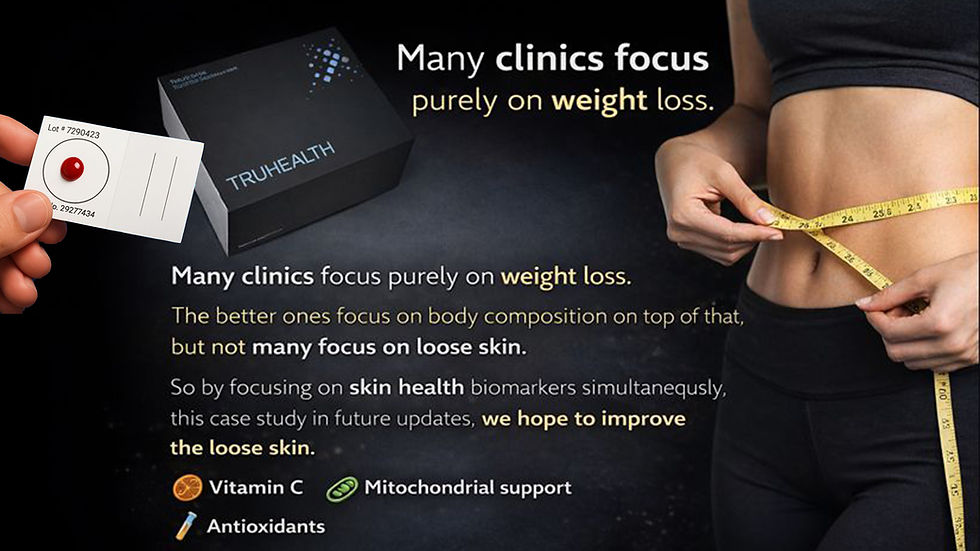
Most clinics focus purely on weight loss metrics. Some go a step further and track body composition. But very few address what happens to the skin.
And that’s where Epic Genetics is positioning itself differently.
“Not many people are talking about loose skin until it becomes a problem,” Valentina explains. “We’re trying to get ahead of it, by looking at the biology driving skin health from the start.”
The strategy involves supporting three key pillars:
1. Fibroblasts: The Skin’s Repair Engine
Fibroblasts are the cells responsible for producing collagen and elastin—the structural proteins that keep skin firm and elastic.
When these cells are functioning optimally, the skin can adapt to changes in body composition. When they’re not, elasticity declines.
Supporting fibroblast activity becomes critical during weight loss.
2. Mitochondrial Function and ATP Production
Skin remodelling is an energy-intensive process. Collagen synthesis, elastin repair, and cellular turnover all require ATP.
This is where mitochondria come in.
“If your mitochondria aren’t functioning properly, your skin simply doesn’t have the energy to remodel,” says Valentina. “It’s not just a cosmetic issue—it’s a cellular energy problem.”
Supporting mitochondrial function ensures that fibroblasts can do their job efficiently.
3. Targeted Nutritional and Topical Interventions
The case study incorporates several targeted strategies:
Vitamin C – Essential for collagen synthesis
Antioxidants – Reduce oxidative stress during rapid fat loss
Mitochondrial support compounds – Help sustain ATP production
Topical GHK-Cu (Copper Peptide) – A key focus of the protocol
GHK-Cu: A Key Player in Skin Remodelling
One of the more interesting elements of this approach is the use of GHK-Cu, a copper peptide with well-documented effects on skin biology.
Research has shown that GHK-Cu can:
Upregulate collagen and elastin gene expression
Improve skin thickness and firmness
Enhance wound healing and tissue repair
In this context, it’s being used to counteract the mechanical and biological stress of rapid fat loss.
When combined with hyaluronic acid, the effect may be enhanced through improved hydration and skin plumpness.

Biomarkers Over Guesswork
What sets this approach apart is the use of biomarker data to guide decisions.
Rather than applying generic protocols, Epic Genetics tracks indicators related to:
Skin health
Inflammation
Mitochondrial function
Biological aging
This allows interventions to be personalised and adjusted over time.
“It’s not about throwing supplements at the problem,” Valentina explains. “It’s about understanding what the body actually needs and responding to that.”

A Shift in Mindset
This case study isn’t just about one individual—it reflects a broader shift in how weight loss should be approached.
The traditional model focuses on:
Speed
Scale weight
Short-term results
But this newer model focuses on:
Sustainability
Cellular health
Long-term appearance and function
“The best results come from synergy,” Valentina says. “Lifestyle, nutrition, and targeted interventions working together—not one or the other.”
Looking Ahead
The case study is ongoing, and future updates aim to show how combining these strategies impacts outcomes over time—particularly in relation to loose skin and overall skin quality.
Early signs suggest that taking a more integrated approach may not only improve aesthetics but also support healthier aging at a cellular level.
And that may ultimately be the real goal.
Final Thought
Weight loss is no longer just about losing fat—it’s about how the body adapts in the process.
Because the difference between looking “smaller” and looking healthier, younger, and more resilient often comes down to what’s happening beneath the surface.
As Valentina puts it:
“Anyone can help you lose weight. The real question is—what happens to your body while you’re doing it?”


Comments