
MOTS-c and Mitochondrial Optimisation: A Case Study Review
Updated: Jul 15
Mitochondrial health sits at the centre of nearly every longevity conversation. From energy production to metabolic flexibility and cellular resilience, the mitochondria ultimately determine how efficiently we age.
One emerging intervention that has gained attention in both research and biohacking circles is MOTS-c, a mitochondrial-derived peptide believed to regulate metabolic stress and enhance cellular efficiency. While preclinical data is promising, real-world human data remains limited.
In this article, we summarise four individual case studies using MOTS-c across 1-2 month cycles , examining its impact on mitochondrial biomarkers, energy regulation, and metabolic health.
What is MOTS-c?
MOTS-c is a peptide encoded within mitochondrial DNA. Unlike most peptides, which are nuclear-derived, MOTS-c acts as a mitochondrial signalling molecule, influencing:
Glucose metabolism
Insulin sensitivity
Cellular stress responses
Mitochondrial biogenesis and efficiency
Mechanistically, MOTS-c is thought to activate AMPK pathways, mimicking some effects of exercise and caloric restriction—two of the most well-established longevity interventions.

Study Design Overview
Across the four individuals:
Cycle length: 4–9 weeks
Dosing: Varied (reflecting real-world use rather than a fixed protocol)
Measurements: Functional proteomics focusing on mitochondrial and energy-related markers
The goal was not to create a controlled trial, but rather to identify consistent directional trends in real-world use.
Key Finding #1: Mitochondrial Energy Production Improved
One of the most consistent findings across all four individuals between the three month TruHealth epigenetic tests was an improvement in markers related to mitochondrial energy production.
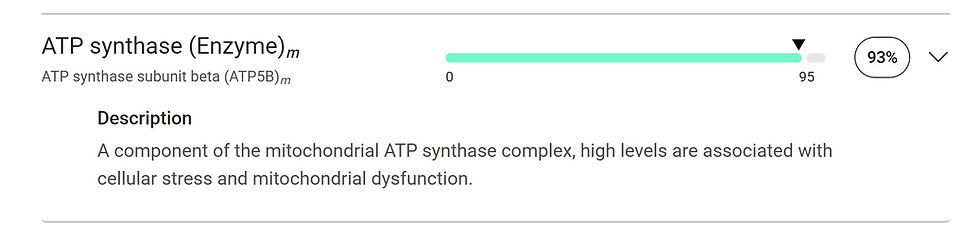
ATP Synthase (ATP5B)
ATP5B is a subunit of ATP synthase—the enzyme responsible for generating ATP, the body’s primary energy currency.
Across the cohort:
Average improvement: +9.5 points
This suggests a more efficient ATP production system, which could translate into:
Improved physical performance
Better recovery
Increased metabolic efficiency
Importantly, these changes reflected a normalisation toward optimal ranges, rather than excessive upregulation.
Key Finding #2: Mitochondrial Dynamics Became More Balanced
Another notable shift was seen in:
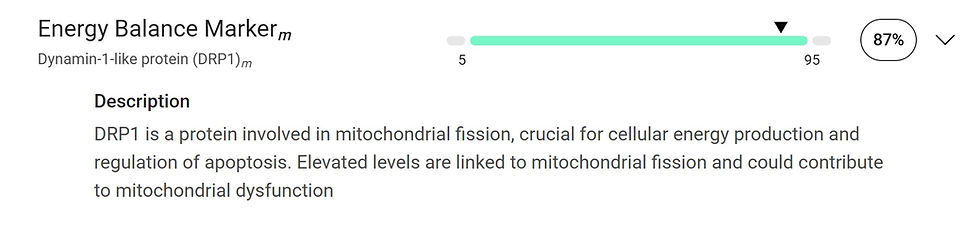
Dynamin-1-like protein (DRP1)
DRP1 plays a key role in mitochondrial fission, the process by which mitochondria divide.
While fission is necessary, excessive activity is often linked to:
Mitochondrial fragmentation
Cellular stress
Reduced efficiency
Across the four individuals:
Average normalisation: +13 points
This suggests MOTS-c may help restore balance between mitochondrial fission and fusion, supporting healthier mitochondrial networks and improved energy stability.
Key Finding #3: Broad Mitochondrial Stress Reduction
Looking more broadly, mitochondrial markers showed a consistent trend toward normalisation rather than overstimulation.
This is an important distinction.
Rather than pushing pathways aggressively, MOTS-c appears to act more as a regulator, helping the system return to a more optimal baseline. This aligns with its proposed role as a metabolic stress-response peptide, similar to signals activated during exercise or fasting.
Key Finding #4: Nutrient Interaction – The Riboflavin (Vitamin B2) Effect
One of the most interesting observations came from an individual who did not supplement vitamin B2 (riboflavin) during their MOTS-c cycle.
Riboflavin levels dropped by 17%
Riboflavin is essential for:
Electron transport chain function
FAD/FMN cofactor production
Mitochondrial energy metabolism
A likely explanation is that MOTS-c increases mitochondrial demand, leading to greater utilisation of key micronutrients.
In simple terms:
As mitochondrial efficiency improves, nutrient demand increases.
This highlights the importance of supporting mitochondrial cofactors, particularly B vitamins, when running a MOTS-c protocol.

The same patient, who used MOTS-c for nine weeks, also experienced a modest 4% reduction in vitamin B5 levels. One possible explanation is that increased mitochondrial activity may elevate the demand for coenzyme A (CoA), which is synthesized from pantothenic acid (vitamin B5). The relatively small decline in vitamin B5 suggests that CoA metabolism may benefit from efficient recycling and conservation mechanisms within the cell, reducing the need for large amounts of new synthesis. While this remains speculative, it could help explain why vitamin B5 depletion was comparatively modest despite prolonged MOTS-c use and increased metabolic demand.
Key Finding #5: Improvements in Epigenetic HbA1c
Another consistent trend across all four individuals was an improvement in epigenetic HbA1c, with reductions ranging from:
4% to 18%
What is HbA1c?
HbA1c (glycated haemoglobin) is a marker that reflects average blood glucose levels over the past 2–3 months. Higher levels indicate poorer glucose control and are associated with increased risk of:
Insulin resistance
Metabolic dysfunction
Cardiovascular disease
Looking at the average across all four participants, TruHealth epigenetic HbA1c improved by 12 points, while the glucose marker improved by an average of 15 points.
The TruHealth glucose marker appears to provide a broader picture of glucose regulation, reflecting both long-term average glucose levels and glucose variability or spikes. By comparison, the epigenetic HbA1c marker appears to offer a more holistic view of cumulative glucose exposure over time, potentially capturing broader biological consequences of glucose metabolism and glycation rather than average blood glucose alone. Together, these findings suggest that MOTS-c was associated with consistent improvements in overall metabolic health across the cohort, with benefits extending across multiple measures of glucose regulation.
Epigenetic HbA1c provides an additional layer of insight, reflecting how gene expression patterns
What This Means
The consistent reduction in HbA1c suggests that MOTS-c may:
Improve glucose handling and insulin sensitivity
Enhance metabolic flexibility
Support a more favourable long-term metabolic profile
This aligns strongly with MOTS-c’s proposed activation of AMPK, a key regulator of glucose metabolism.
Case Study Summary
Across the four individuals, several consistent patterns emerged:
ATP production improved (ATP5B ↑ ~9.5 points)
Mitochondrial dynamics normalised (DRP1 ↑ ~13 points)
Mitochondrial stress markers moved toward optimal ranges
Epigenetic HbA1c decreased by 4–18%
Increased nutrient demand observed, particularly for vitamin B2
Despite variations in dose and cycle length, the direction of change was highly consistent, strengthening the signal of a real physiological effect.
Practical Takeaways
From a practical standpoint, these case studies suggest that MOTS-c may:
Improve mitochondrial efficiency, rather than simply stimulating output
Enhance metabolic flexibility, particularly in glucose regulation
Require nutritional support, especially B vitamins
Work best as part of a broader longevity protocol
Final Thoughts
While these are small-scale observations, they offer valuable insight into how MOTS-c performs in real-world use.
Rather than acting as a blunt performance enhancer, MOTS-c appears to function as a metabolic regulator, improving efficiency across both mitochondrial and glucose pathways.
The combination of:
Enhanced ATP production
Improved mitochondrial dynamics
Better glucose control
suggests a system that is not just working harder—but working more intelligently and sustainably.
As always, larger controlled studies are needed. But these early findings provide a compelling signal that MOTS-c may play a meaningful role in advanced longevity and metabolic optimisation strategies.
Disclaimer
The peptide referenced in this article, were sourced personally by 50% particpants from Elvian Labs, selected due to their provision of up-to-date independent testing for purity and microbial safety. This reference is provided for transparency only and does not constitute a recommendation, endorsement, or medical advice.
Any client results discussed are shared voluntarily by those individuals, based on peptides they chose to source and use under their own initiative.
Epic Genetics does not prescribe, recommend, supply, or advise on the use of peptides or other prescription-only substances.
The information presented is for educational and informational purposes only and should not be interpreted as medical guidance. Individuals are responsible for their own health decisions and should consult an appropriately qualified healthcare professional before using any pharmacological or peptide-based interventions.


Comments