
SS-31 Peptide Experience (Elamipretide)
Updated: Jun 4
A Mitochondrial Repair Strategy Backed by Biomarkers
Featuring Tony Pemberton - Founder
Mitochondrial health is increasingly recognized as one of the most upstream drivers of aging and disease. While many longevity strategies focus on suppressing pathways like mTOR or improving metabolic markers, repairing mitochondrial dysfunction directly may be one of the most powerful interventions available today.
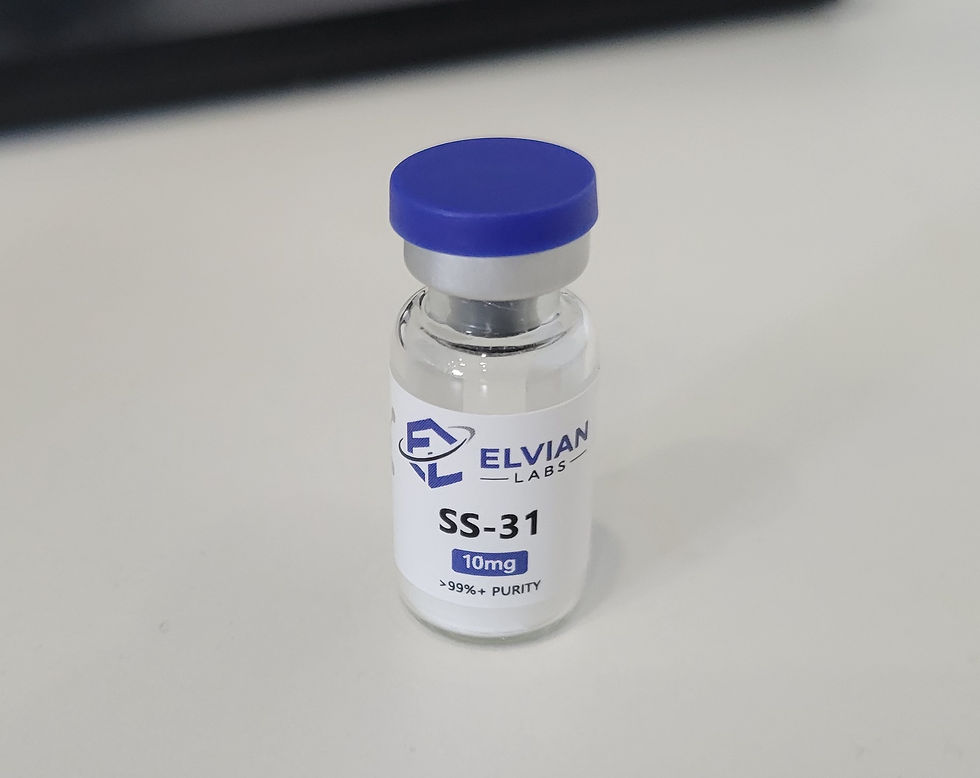
One compound gaining significant attention in the biohacking and longevity communities is SS-31, also known as elamipretide. This mitochondrial-targeting peptide has been studied extensively for its ability to restore mitochondrial function, improve energy production, and reduce oxidative damage.
In this article, I’ll explain how SS-31 works, why it matters for mitochondrial health, and how I’m currently testing it in my own longevity protocol using continuous biomarker tracking and epigenetic testing such as TruDiagnostic’s TruAge and TruHealth reports.

How SS-31 Works: Targeting Cardiolipin in the Mitochondria
SS-31 works by binding to cardiolipin, a unique lipid found in the inner membrane of mitochondria.
Cardiolipin plays a critical role in maintaining the structure of the mitochondrial electron transport chain — the system responsible for producing cellular energy in the form of ATP.
As we age, cardiolipin becomes oxidized and damaged, which disrupts mitochondrial efficiency. This leads to several downstream effects:
Reduced ATP production
Increased reactive oxygen species (ROS)
Mitochondrial membrane instability
Declining cellular energy output
SS-31 helps stabilize cardiolipin, allowing mitochondria to restore more efficient energy production and reduce oxidative stress.
This mechanism is why SS-31 has attracted attention in clinical research, particularly for conditions involving mitochondrial dysfunction.
FDA Interest and Rare Mitochondrial Diseases
One of the clearest examples of cardiolipin dysfunction occurs in a rare genetic disorder called Barth syndrome, which affects roughly one in a million people.
Individuals with Barth syndrome experience severe mitochondrial dysfunction due to abnormal cardiolipin metabolism. This can result in:
Poor muscle development
Delayed puberty
Cardiomyopathy and heart failure
Exercise intolerance
In clinical trials, patients treated with SS-31 demonstrated meaningful improvements in physical performance, including increases of 80–90 meters in the six-minute walk test, representing roughly a 15–20% improvement.
In these studies, patients often received 40 mg daily doses for several months, which demonstrates the therapeutic potential of the peptide when mitochondrial dysfunction is severe.
My Personal SS-31 Protocol
While clinical studies use high doses, those levels would be extremely expensive in a biohacking context.
Instead, I’m experimenting with a lower-dose protocol:
1 mg of SS-31 daily for 70 days
This still represents a significant investment but allows for a longer exposure period to observe trends in metabolic and mitochondrial biomarkers.
Many biohackers use a different approach — typically 5 mg daily for 20 days — but my hypothesis is that lower doses over a longer period may provide better return on investment, particularly when tracking long-term biological markers.
To test this properly, I track multiple physiological signals:
Continuous glucose monitoring
Cardio performance metrics
Heart rate variability (HRV)
Resting heart rate
Epigenetic biomarkers from TruDiagnostic testing
Early Observations: Glucose Stability and Metabolic Efficiency
One of the most interesting observations so far involves glucose control.
Glucose handling is a surprisingly good proxy for mitochondrial function because efficient mitochondria are better able to process energy substrates.
Using a continuous glucose monitor, I compared identical meals months apart.
Despite eating a higher-fat Wagyu burger meal, my post-meal glucose spike was around 2 mmol/L lower than a comparable meal I had previously recorded.
This suggests improved metabolic flexibility — potentially due to improved mitochondrial efficiency.
Another example occurred during a hotel stay where I repeated the same breakfast and sauna routine across two days.
The only difference?
On the second day, I administered SS-31 prior to the meal.
The result was roughly a 1.5 mmol/L lower glucose spike, which is a substantial change.
While this is still anecdotal data, it aligns with the hypothesis that improved mitochondrial function enhances energy utilization.
Improvements in Cardio Output
Another interesting metric is cardio performance.
I measure my cardio output using a consistent 20-minute high-intensity effort while reading news subtitles — a routine that allows reliable comparison across months and years.
Historically, my best output was 327 calories in 20 minutes, with most sessions averaging closer to 320–323 calories.
On the first day of my SS-31 cycle, I unexpectedly hit a new record after administering the peptide earlier that day.
Later in the cycle, I also maintained outputs of 320+ calories, even after poor sleep — something that normally reduces my performance.
This could be linked to improved mitochondrial efficiency, where electron transport chain function improves and energy leakage decreases, allowing more efficient energy production.
Tracking Mitochondrial Biomarkers with Epigenetic Testing
One of the most valuable tools for evaluating these interventions is epigenetic testing.
Using TruDiagnostic’s TruAge and TruHealth reports, I track multiple biomarkers related to mitochondrial function and aging.
Two markers I’m particularly interested in include:
ATP5B
A marker linked to mitochondrial ATP synthase efficiency.
Lower values generally indicate more efficient mitochondrial energy production.
DRP1 (Dynamin-Related Protein 1)
DRP1 regulates the balance between mitochondrial fusion and fission.
Previously, optimal values were believed to be low, but updated TruDiagnostic algorithms now suggest the ideal range sits around the 50th percentile, reflecting a balanced mitochondrial network.
In my last test, this marker was extremely elevated, indicating imbalance in mitochondrial dynamics.
My upcoming mid-cycle epigenetic test will help determine whether mitochondrial repair strategies like SS-31 improve this marker.
Real-World Client Example: Improving Mitochondrial Balance
In one client case, a 57-year-old male followed a protocol using MOTS-c first, followed by SS-31.
When we examined his TruDiagnostic epigenetic biomarkers, the DRP1 marker landed exactly at the 50th percentile, indicating a well-balanced mitochondrial fusion-fission dynamic.
(Insert visual DRP1 biomarker graphic here)
This type of data reinforces the idea that mitochondrial peptides may work best when sequenced strategically, rather than used randomly.

Sequencing Mitochondrial Peptides: Repair vs Biogenesis
A common question is whether mitochondrial peptides like MOTS-c and SS-31 should be used together.
My current view is that sequential use may be more effective than concurrent use.
For example:
MOTS-c
Activates AMPK
Stimulates mitochondrial biogenesis
SS-31
Repairs damaged mitochondria
Stabilizes cardiolipin
This creates a two-step approach:
Build mitochondria → Repair mitochondria
However, the order may depend on an individual’s metabolic health.
For people with significant metabolic dysfunction, starting with MOTS-c may produce larger improvements.
Side Effects and Practical Considerations
SS-31 appears relatively well tolerated.
The most commonly reported side effects include:
Mild injection-site redness
Occasionally altered sleep quality
Personally, I haven’t experienced any significant issues so far.
One important factor is peptide sourcing, as purity can vary significantly between suppliers.
The Future of SS-31 in Longevity
Mitochondrial dysfunction is one of the central hallmarks of aging, influencing everything from cardiovascular health to metabolic disease and neurodegeneration.
Because SS-31 targets mitochondria directly, it represents a very upstream intervention in the aging process.
Over the next five years, I suspect SS-31 will become significantly more mainstream as more clinical and real-world data emerges.
By combining continuous biomarker tracking, epigenetic testing, and structured peptide protocols, we can begin to understand which mitochondrial interventions truly move the needle.
Through tools like TruDiagnostic testing, including TruAge and TruHealth reports, we now have the ability to monitor these changes at the biological level rather than relying purely on subjective observations.
And that’s where longevity research becomes truly exciting.
Disclaimer
The peptides referenced in this article were sourced personally by the author from Elvian Labs, selected due to their provision of up-to-date independent testing for purity and microbial safety. This reference is provided for transparency only and does not constitute a recommendation, endorsement, or medical advice.
Any client results discussed are shared voluntarily by those individuals, based on peptides they chose to source and use under their own initiative.
Epic Genetics does not prescribe, recommend, supply, or advise on the use of peptides or other prescription-only substances.
The information presented is for educational and informational purposes only and should not be interpreted as medical guidance. Individuals are responsible for their own health decisions and should consult an appropriately qualified healthcare professional before using any pharmacological or peptide-based interventions.


Comments